Redazione
Il webinar del progetto dedicato a Toni Muzi Falconi, verso il World Public Relations Forum 2026 di Abuja.
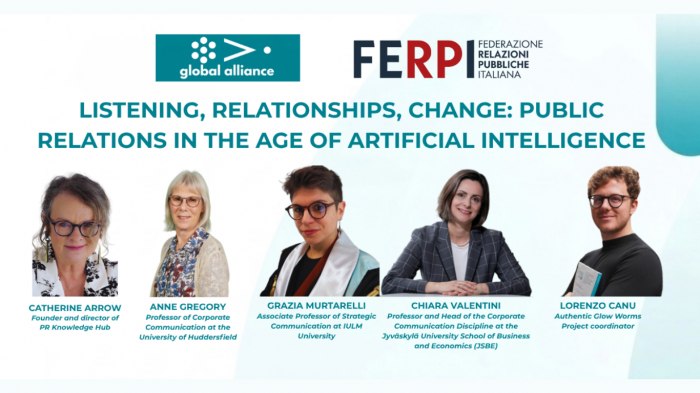
Si è tenuto il webinar di Authentic Glow Worms, il progetto internazionale dedicato al pensiero e all’eredità professionale di Toni Muzi Falconi, realizzato da FERPI e dalla Global Alliance for Public Relations and Communication Management in vista del World Public Relations Forum 2026 di Abuja, dove la Global Alliance dedicherà a Toni la giornata di apertura. Un’ora di conversazione attorno ai tre temi del progetto, ascolto, relazioni e cambiamento, nel momento in cui automazione e intelligenza artificiale stanno riscrivendo la professione. Lo spirito, fedele a quello di Toni, era quello di non celebrare un’eredità ma di continuarla: mettere le quattro voci in dialogo tra loro, lasciando che i tre temi si intrecciassero.
Ad aprire è stato un videomessaggio dello stesso Toni, che ci ha seguiti da Milano e ha ringraziato i contributori. A moderare, Lorenzo Canu, coordinatore del progetto e tutor di comunicazione strategica alla University of Technology Sydney.
Catherine Arrow, founder e director di PR Knowledge Hub e tra le pioniere su AI e relazioni pubbliche, ha presentato un contributo interattivo, “The Third Presence: Our New Relationship Dimension”, nato da oltre vent’anni di conversazioni con Toni. La sua tesi: l’AI non è più uno strumento ai margini del nostro lavoro, ma una “terza presenza” nell’ambiente stesso in cui le relazioni si formano, si interpretano e si sostengono, un intermediario che filtra e distorce le conversazioni che avviamo. Quella relazione, un tempo “atomo” al centro della pratica, vive ora in una datasphere plasmata da tecnologie spinte da chi le governa, spesso per profitto e non per progresso: i veri stakeholder, ha ricordato, sono le persone dietro la maschera.
Il suo monito ai professionisti è netto: smettere di guardare indietro e non fare retrofit dell’AI sui vecchi modelli. “Non metteresti un motore su un cavallo per farlo andare più veloce: lo uccideresti e basta”. La via d’uscita è tenere l’umano al centro e guidare la tecnologia con il suo AI Compass, quattro punti cardinali, insight, immaginazione, implementazione e integrità, facendo advocacy perché l’etica non resti scaricata sul singolo professionista mentre chi possiede i modelli resta senza regole.
Anne Gregory, Emeritus Professor alla University of Huddersfield e già Chair della Global Alliance, ha affidato il suo intervento a un contributo video, “AI and the Transformation of Human Relationships”. Il suo tema: l’AI non sta ridisegnando solo la tecnologia e il lavoro, ma la natura stessa delle relazioni. Amicizie, legami di comunità e rapporti con gli stakeholder sono sempre più mediati online, dove dominano voci polarizzanti e automatizzate e la verità è ciò che è dominante, non ciò che è accurato.
Ha messo in guardia dalle decisioni “guidate dai dati” anziché informate dai dati, dalla nascita di una sottoclasse digitale e dal rischio di una ri-colonizzazione via AI con i modelli occidentali. La sua affermazione più netta: “le relazioni sono di competenza dell’umano. Possiamo creare relazioni con i bot, ma loro non possono crearle con noi: le simulano”. Di qui l’appello a non delegare le relazioni alla tecnologia e a difendere ciò che rende buoni gli esseri umani: empatia, correttezza, senso di giustizia, affidabilità.
Grazia Murtarelli, Associate Professor alla IULM, con Stefania Romenti, ha firmato “Listening as an Organisational Choice: From Stakeholder Signals to Relational Governance”. Il contributo rilegge l’ascolto organizzativo come capacità strategica e non semplice monitoraggio: avere molti dati sugli stakeholder non significa saperli ascoltare. “Le organizzazioni hanno accesso a molte informazioni, ma non per questo sono buoni ascoltatori”; l’ascolto acquista senso solo quando le informazioni diventano insight che guidano l’azione.
Ha proposto tre dimensioni interconnesse, il riconoscimento dei segnali, l’interpretazione relazionale e la responsiveness organizzativa, e ha richiamato il paradosso della visibilità degli stakeholder: nell’era dei motori di ricerca generativi si tende a dare attenzione alle voci più visibili e potenti, ma i segnali più importanti arrivano spesso da chi ha meno opportunità di farsi sentire. L’ascolto, così inteso, diventa un’infrastruttura di governance relazionale.
Chiara Valentini, Professor and Head of Corporate Communication alla University of Jyväskylä, ha presentato “Professional Roles After Automation: Toni Muzi Falconi’s Relationship Legacy”. Partendo da uno studio ventennale sulle professioni della comunicazione in Italia, ha mostrato come i confini tra giornalismo e relazioni pubbliche siano diventati porosi e come i ruoli siano oggi plasmati dalla tecnologia. Il cuore è la diplomazia di Toni intesa non come tattica ma come relazione etica, fatta di ascolto attento, sensibilità al contesto e pazienza nel costruire fiducia.
La sua tesi è un paradosso: “più la comunicazione si automatizza, più il giudizio umano diventa centrale, pur rischiando di restare strutturalmente marginale”, una riserva a cui ricorrere solo quando il sistema fallisce. Fino all’immagine di media relations in cui un comunicatore-agente AI tratta con un giornalista-agente AI, e la domanda che ne consegue: dov’è l’umano? La risposta, per Chiara, sta in ciò che la tecnologia non può offrire: la cura, l’empatia, la responsabilità morale.
A chiudere gli interventi, i saluti istituzionali di Fabrizio Vignati, presidente di FERPILab, il think tank di FERPI di cui Toni è presidente onorario. Vignati ha posto la domanda di fondo, cosa deve cambiare nella professione e cosa non deve cambiare mai, ha collegato il tema all’eredità di James Grunig, da lui recentemente curato in una selezione italiana, e ha richiamato la nuova collaborazione tra FERPI e Ipsos sotto l’ombrello di FERPILab: connettere i professionisti ai dati, con le relazioni al primo posto e decisioni informate dai dati, non guidate dai dati.
Il Q&A, con un pubblico internazionale e partecipe, ha toccato due nodi concreti: come integrare l’AI nei corsi universitari di relazioni pubbliche e comunicazione, e fino a che punto, pur senza delegare le decisioni, si possa affidare all’AI l’interpretazione dei dati. È emerso il valore delle discipline umanistiche e della lettura come palestra di pensiero critico, e un approccio didattico condiviso: far formulare agli studenti un primo giudizio, poi metterlo alla prova con l’AI, infine spiegare cosa accettano, cosa rifiutano e perché. A salutare i partecipanti è intervenuto anche il Dr Ike Neliaku, presidente del Nigeria Institute of Public Relations e host del Forum, che ha invitato tutti ad Abuja.
In chiusura, il senso del progetto: onorare l’eredità di Toni significa continuare a interrogarsi, continuare ad ascoltare e, in un mondo sempre più rumoroso, continuare a cercare quelle piccole luci autentiche, le glow worms. Tutti i contributi sono raccolti su authenticglowworms.com, e il progetto resta aperto a nuovi contributi fino al Forum di Abuja. Per approfondire, l’editoriale di lancio e la registrazione del webinar.
The project webinar honouring Toni Muzi Falconi, towards the World Public Relations Forum 2026 in Abuja.
The Authentic Glow Worms webinar brought together four leading scholars and practitioners around the three themes at the heart of Toni Muzi Falconi’s work: listening, relationships and change. The project, developed by FERPI and the Global Alliance for Public Relations and Communication Management, leads up to the World Public Relations Forum 2026 in Abuja, where the Global Alliance will dedicate the opening day to Toni. True to his spirit, the aim was not to celebrate a legacy but to continue it, putting the four voices in conversation and letting the three themes intertwine.
The session opened with a short video message from Toni, following from Milan, and was moderated by Lorenzo Canu, coordinator of the project, and a tutor in strategic communication at the University of Technology Sydney.
Catherine Arrow, founder and director of PR Knowledge Hub and a pioneer on AI and public relations, presented an interactive contribution, “The Third Presence: Our New Relationship Dimension”, drawn from more than twenty years of conversation with Toni. Her argument: AI is no longer a tool at the edge of our work but a third presence in the very environment where relationships are formed, interpreted and sustained, an intermediary that filters and distorts the conversations we begin. That relationship, once the “atom” at the centre of practice, now lives in a datasphere shaped by technologies driven, too often, by profit rather than progress; the real stakeholders, she noted, are the people behind the mask.
Her message to practitioners is blunt: stop looking backwards and don’t retrofit AI onto old models. “You wouldn’t put an engine on a horse to make it go faster, you’d just kill the horse”. The way forward is to keep humans at the heart and steer the technology with her AI Compass, four points, insight, imagination, implementation and integrity, advocating so that ethics is not pushed onto the individual practitioner while the owners of the models go unregulated.
Anne Gregory, Emeritus Professor at the University of Huddersfield and former Chair of the Global Alliance, gave her talk as a video contribution, “AI and the Transformation of Human Relationships”. Her theme: AI is reshaping not just technology and work but the very nature of relationships. Friendships, community ties and stakeholder relationships are increasingly mediated online, where polarising and automated voices dominate and truth is what is dominant, not what is accurate.
She warned against “data-led” rather than data-informed decisions, an emerging digital underclass and the risk of a new AI colonisation through Western models. Her sharpest claim: “relationships are the province of the human. We can form relationships with bots, but they cannot form relationships with us: they simulate them”. Hence her call to resist delegating relationships to technology and to protect what makes for good human beings: empathy, fairness, a sense of justice and trustworthiness.
Grazia Murtarelli, Associate Professor at IULM, with Stefania Romenti, presented “Listening as an Organisational Choice: From Stakeholder Signals to Relational Governance”. The piece reframes organisational listening as a strategic capability rather than mere monitoring: having a lot of stakeholder data does not make an organisation a good listener. “Organisations have access to a great deal of information, but that does not make them good listeners”; listening gains meaning only when information becomes insight that leads to action.
She set out three interconnected dimensions, recognising signals, relational sensemaking and organisational responsiveness, and highlighted the paradox of stakeholder visibility: in the age of generative search we tend to attend to the most visible and powerful voices, yet the most important signals often come from those with the least opportunity to be heard. Listening, so understood, becomes an infrastructure of relational governance.
Chiara Valentini, Professor and Head of Corporate Communication at the University of Jyväskylä, presented “Professional Roles After Automation: Toni Muzi Falconi’s Relationship Legacy”. Drawing on two decades of research into Italy’s communication professions, she showed how the boundaries between journalism and public relations have grown porous and how roles are now shaped by the technology people use. At the core is Toni’s diplomacy, understood not as tactic but as an ethical relationship, built on attentive listening, contextual sensitivity and the patience to build trust.
Her argument is a paradox: “the more communication is automated, the more human judgement matters, even as it risks being pushed to the structural margins”, a backup for when the system fails. She left the panel with a striking image of media relations in which an AI communicator negotiates with an AI newsroom, and the question that follows: where is the human? Her answer lies in what technology cannot offer: care, empathy and moral accountability.
The talks closed with institutional greetings from Fabrizio Vignati, President of FERPILab, the FERPI think tank of which Toni is honorary President. Vignati posed the underlying question, what must change in the profession and what must never change, connected it to the legacy of James Grunig, whom he recently edited in an Italian selection, and noted FERPI’s new knowledge exchange with Ipsos under the FERPILab umbrella: connecting professionals to data, with relationships first and decisions data-informed, not data-led.
The Q&A, with an engaged international audience, turned on two concrete questions: how to embed AI in university PR and communication courses, and how far, short of delegating decisions, we can delegate the interpretation of data to AI. The value of the humanities and of reading, as training for critical thinking, came up, along with a shared teaching approach: have students form a first judgement, test it with AI, and then explain what they accept, reject and why. Among those present, Dr Ike Neliaku, President of the Nigeria Institute of Public Relations and host of the Forum, greeted participants and invited everyone to Abuja.
The closing thought captured the spirit of the project: the best way to honour Toni’s legacy is to keep questioning, keep listening, and, in an increasingly noisy world, keep looking for the small, authentic lights, the glow worms. All contributions are gathered at authenticglowworms.com, and the project remains open to new contributions up to the Forum in Abuja. To go deeper, the launch editorial and the webinar recording.